Why College Players Are More Predictable Than Rec Players
The Switching Pattern That Gives You Away
In addition to choosing the right balance of wide and T serves, a sophisticated tennis player has to also think about their patterns of serving to each side of the service box. As discussed (here), professional tennis players are hitting wide and T with the right overall balance.
But a really good returner (maybe an Andre Agassi or Iga Swiatek) could still exploit detectable patterns–think wide, wide, wide, T, T, T. And indeed, research found that the pros exhibit what researchers call "negative serial correlation". Basically, they switch serve directions more often than a coin flip would predict–wide, T, wide, T.
According to the research, if a male pro just hit wide the last time he served from the deuce court, chances were 42% that he would hit there again the next time (compared to the 50% random chance would predict). For professional women, chances were she would serve wide again 34% of the time on the next serve. In short, if a pro serves wide to your forehand, they're more likely to come back to your backhand next than pure chance would suggest.
An Unexpected Discovery in Our Data
Here's where SwingVision's incredible dataset of hundreds of recreational and college matches and Next Level Stats’ analysis revealed something actionable for everyone. While men and women’s D1 players exhibit an even more exaggerated tendency to switch wide, T, wide, T, recreational players do the opposite.
After serving to your right, a D1 men’s player is likely to repeat to that side 34% of the time. That’s true for either first or second serve! For D1 women, they repeat to the same side 43% of the time. Like the pros, they're aware of the need to be unpredictable, but they're overdoing it.
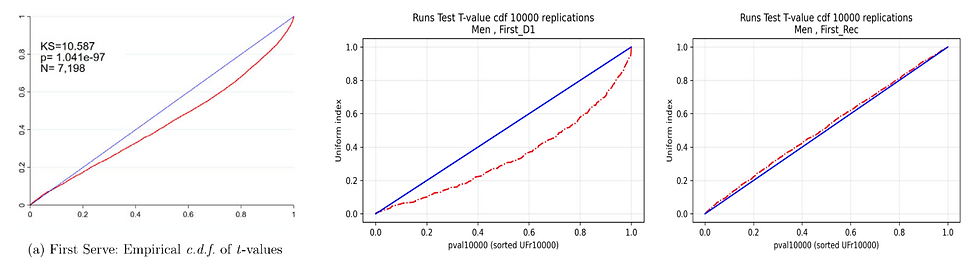
Recreational men, meanwhile, show positive serial correlation on first serves—they switch too infrequently. After serving to your backhand, they're likely to go there again (hey, if it ain’t broke…). But here's the twist: recreational players are overall less predictable than college players because their patterns are weaker and less consistent.
Why Does This Happen?
Now, no one is claiming rec players are better servers. But in terms of predictability, you might imagine there is some pure randomness baked into a rec player’s serve. When you're a NTRP 3.5 player, sometimes your serve just goes where it goes, creating natural randomization that's not part of any conscious strategy. D1 players, by contrast, have very precise serve control and are consciously trying to be unpredictable, creating a different kind of exploitable pattern.
For coaches working with players at the highly competitive junior or college level, as your players gain control, you need to simultaneously train strategic randomization. If you think this might be you, first you need to systematically measure if you’re doing this in matches, and then talk to your coach about it. The awesome insights that SwingVision and other AI computer vision tools provide make this measurable—you can literally show players their switching patterns and help them develop more unpredictable patterns.
Some tried and true strategies for true randomization on the court include looking at your watch and dividing the seconds into thirds (or quarters, or whatever) to tell you where to serve on a normal point (but probably still go with your best stuff on break point down).
If you don’t wear a watch, look at the first two things you see and add up the letters in each–2/3 will be an even sum and 1/3 odd–et voila!
Give it a try and see what you think. And if you want to dig even deeper, check out this interesting nuance on women's second serves.


Comments